
Codex Labelling – risky proposals for emergencies
IBFAN opposes flexible labelling during emergencies
CCFL49 – The 49th Session of the Committee on Food Labelling (CCFL49) will be held in Ottawa, Canada from 11 – 15 May 2026
IBFAN will be attending the 49th session of the Codex Labelling Committee in Ottawa, Canada in May to address items that affect maternal and young child health, please help us contact Codex delegates to encourage them to read our statement. You can find the Codex delegations HERE
We are most concerned about a proposal by the USA that calls for guidelines to allow flexibility regarding product labelling and ingredients for emergencies. IBFAN believes that there is no need for these guidelines (1) and they will do more harm than good. They will create a double standard that will put those in situations of food insecurity, famines and food deprivation at even greater risk.
Here are some of our concerns:
1: Defining an emergency is a highly sensitive political action..
2: Codex has a dual mandate to protect health and facilitate fair trade so its text are often compromised. Codex texts have far-reaching influence on national laws and policies.
3: Flexible labelling opens the door to double standards and exploitation of the most vulnerable
4: Few national governments have adequate emergency preparedness safeguards to stop exploitive labelling.
5: The uncontrolled dissemination of inadequately labelled products is a health and safety risk, especially for infants and young children.
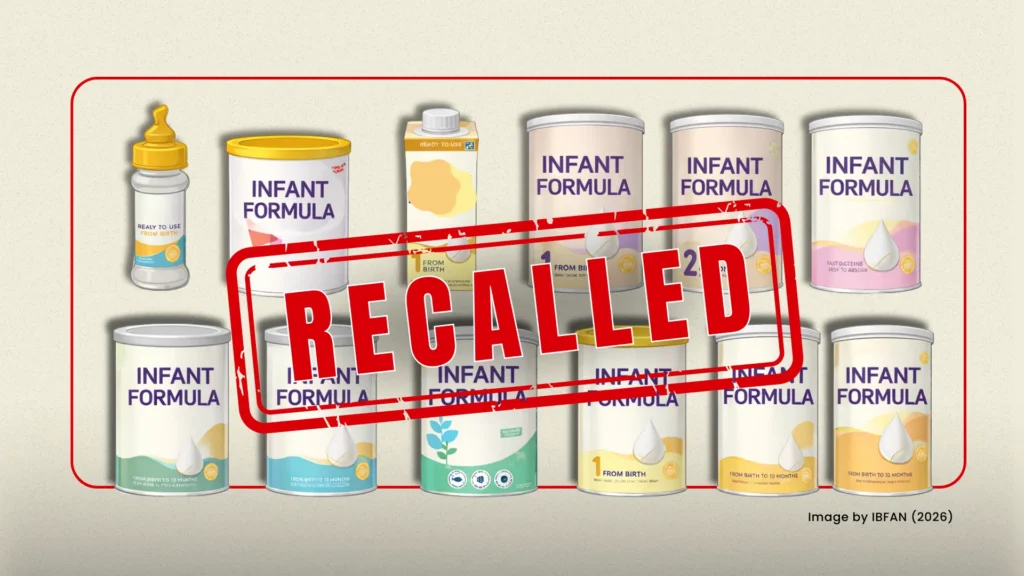
6: For agencies and NGOs working in emergency relief, flexible labelling can complicate the traceability and recall procedures of contaminated or unsafe food. See that formula possibly contaminated with Cereulide has been exported to Ukraine, the Gaza Stip and West Bank.(2)
(1) The EWG summary states that: “In general, most competent authorities regarded that they have the authority, either explicitly stated or implied/embedded within existing interpretations of authorizing legislation, to implement flexibilities to food labelling as necessary in times of emergency.”
(2) RASFF NOTIFICATION 2026.0347 Recall of infant formulae produced in Switzerland, possibly contaminated with cereulide sent from Switzerland to Ukraine, the Gaza Strip and West Bank.
Important links
CCFL49
IBFAN
More
Recall - Nestlé’s credibility questioned as formulas recalled in 60+ countries over contamination risk

Important statements from IBFAN
Check out IBFAN’s statements at CAC47, presented by Patti Rundall (IBFAN).
Agenda Item 5: Labelling Exemptions in Emergencies
Codex Guidelines open the door to commercial exploitation.
Day 3 – 27/11/2024
Original video excerpt from the official Codex Alimentarius Channel.
Agenda Item 5: New Codex standard on baby foods
IBFAN calls for strict safeguards in line with WHO so marketing does not undermine breastfeeding and normal bio-diverse family foods.
Day 3 – 27/11/2024
Original video excerpt from the official Codex Alimentarius Channel.
Agenda Item 12: WHO FAO report
IBFAN welcomes WHO’s work and clarifies that nothing forces mothers to breastfeed. Expresses caution and marketing safeguards on new cell-based formulas that mimmick human milk.
Day 4 – 28/11/2024
Original video excerpt from the official Codex Alimentarius Channel.
Agenda Item 13: Potential webcasting of Executive meeting
IBFAN reminds Codex that it cannot claim to be transparent, then keep important meetings private.
Day 4 – 28/11/2024
Original video excerpt from the official Codex Alimentarius Channel.
Side Event on Labelling
IBFAN highlights the risks of weak Codex standards on national policy setting and the need for more health advocates. Codex also needs to help governments control UPFs.
Side Event – 29/11/2024
Original video excerpt from the official Codex Alimentarius Channel.
Also on our YouTube channel


Codex Photos Copyright: © FAO/WHO Codex Alimentarius
CCFL49
49th Session of the Committee on Food Labelling
Information Notes for Delegates
For more information, visit the official website at FAO – CCFL49
Source: FAO, accessed on 08.05.2026

(English)

Notes:
(1) IBFAN’s briefing outlines how babies, young children and their mothers are most at risk from the toxic chemicals contained in plastics
(2) The Codex Alimentarius Commission (CAC) was established by FAO and WHO to protect consumer health and promote fair practices in food trade – two conflicting objectives. Codex meetings where the recipes, rules and standards that form the basis of national legislation are devised, very often take place away from close public scrutiny. Because of the dominance of agri-food corporations and the powerful exporting nations, it’s almost inevitable that trade takes precedence over health.
Weak Codex standards have been regularly used in attempts to stop governments bringing in strong marketing controls. with interventions made at the WTO concerning commercial milk formula marketing, labelling or safety testing regulations of another member state, wrongly treating Codex standards as a ‘regulatory ceiling’ for trade purposes. In fact, governments have the sovereign right to adopt any legislation they consider necessary to protect child health as long as it does not violate international trade principles,
(2) Guideline on the application of food labelling provisions in emergencies. IBFAN comment (CAC47/CRD51) called for a reference to the Code of Ethics for International Trade in Food including Concessional and Food Aid, Transactions(CXC 20-1979) that states: “National authorities… should also make sure that the International Code of Marketing of BreastMilk Substitutes and relevant resolutions of the World Health Assembly (WHA) … be observed” The draft should also refer to the Operational Guidance on Infant Feeding in Emergencies(OG-IFE) version 3.0 (Oct 2017). Click here for more
(3) Digital marketing is now the predominant source of exposure to misinformation on baby feeding products with enormous cross border extent and power and Brazil is leading many countries in calling for a new World Health Assembly Resolution to regulate the digital marketing of breast-milk substitutes.
-
- For more about why Codex needs to be more serious about tackling the ‘Triple Planetary Crisis’. IBFAN’s briefing for the Global Plastics Treaty explains why babies and young children are so at risk from Plastic. HERE
- To find out why IBFAN has followed Codex so closely over the years see this Compilation of Blogs and Press releases
- Codex Photos Copyright:© FAO/Roberto Sciotti
IBFAN’s full submission to the Codex Labelling Committee is here: IBFAN CCFL49.Ag 7.
You can find all the Codex National Contact points HERE

