
Keep policy-setting free from commercial influence: IBFAN at CCFICS28
At CCFICS28 (Codex Committee on Food Import and Export Inspection and Certification Systems), IBFAN, ENCA and WPHNA called for One Health principles, effective conflict of interest safeguards and special consideration for foods marketed for vulnerable populations.
12-17 October 2026 – Perth, Australia.
Upcoming Codex meetings
CCFICS28
Codex Committee on Food Import and Export Inspection and Certification Systems
12-17 October 2026
Perth, Australia
CCCF19
Codex Committee on Contaminants in Foods
19-23 October 2026
Cairo, Egypt
CCNFSDU45
Codex Committee on Nutrition and Foods for Special Dietary Uses
2-6 November 2026
Nuremberg, Germany
CCFH56
Codex Committee on Food Hygiene
16-20 November 2026
Scottsdale, Arizona, USA
CCFICS28 – Codex Committee on Food Import and Export Inspection and Certification Systems
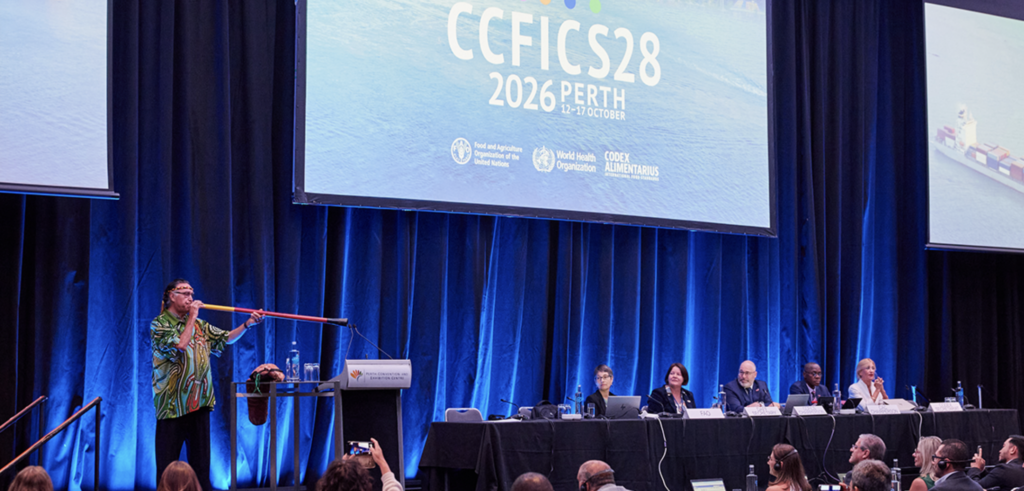
The 28th Session of the Codex Committee on Food Import and Export Inspection and Certification Systems (CCFICS28) is being held in Perth, Australia, from 12 to 17 October 2026.
The meeting is being webcast, with hybrid participation, including for the Physical Working Group on Food Fraud, held on 11 October.
The CCFICS28 agenda includes equivalence, food fraud, traceability and digitalization, and their implications for modern regulation and food security. Baby Milk Action
The plenary session opened on 12 October. The Committee was welcomed by James Webb, from the Noongar tribe, the traditional custodians of the land on which the meeting is taking place. He highlighted the connection between people and the land and the importance of protecting both.
Julie Collins, Minister for Agriculture, Fisheries and Forestry, acknowledged the shared responsibility of food safety and security systems and their importance to agricultural industries and international trade, particularly in the context of emerging science, environmental changes and geopolitical challenges.
Victoria Anderson, Secretary to the Department of Agriculture, Fisheries and Forestry, highlighted equivalence, food fraud, traceability and digitalization among the overarching topics on the CCFICS28 agenda.
For WHO, Simone Moraes Raszl stressed that protecting consumer health must remain at the centre of effective, transparent and science-based inspection and certification systems. Strong national food control systems, effective cooperation between Competent Authorities and timely access to reliable information are essential to prevent and manage food safety risks across borders
Keep policy-setting free from commercial influence
During the Physical Working Group on Food Fraud, held on 11 October, ENCA, IBFAN and the World Public Health Nutrition Association (WPHNA) called for the inclusion of ONE HEALTH principles in the Preamble of the Draft Guidelines on the Prevention and Control of Food Fraud.
The IBFAN/ENCA CRD 19 also calls for the reference to “building partnerships and collaboration” to be removed from paragraph 5 of the Preamble, and for national governments to be encouraged to adopt effective conflict of interest safeguards.
Due diligence is needed to ensure the independence of Competent Authorities and National Food Control Systems, which have the responsibility to monitor, detect, mitigate and prevent food fraud, including through proportionate penalties.
Food fraud involving foods for vulnerable populations presents a particularly high risk to health and to the economic sustainability of families. Labelling and information for products marketed globally for infant and young child feeding, as well as “nutritional” products for pregnant and lactating women, therefore deserve special consideration.
Misrepresentation and false misinformation on product labels and through digital and other marketing methods is invariably intentional, and undermines breastfeeding and recommended optimal feeding practices based on culturally appropriate family foods
Food fraud involving foods for vulnerable populations presents a particularly high risk to health and to the economic sustainability of families.
IBFAN submission on the draft guidelines
IBFAN’s concerns regarding the prevention and control of food fraud are primarily focused on labelling and information for products marketed globally for infant and young child feeding and “nutritional” products for pregnant and lactating women.
IBFAN considers that misleading and deceptive claims on labels and marketing tools qualify as misrepresentation and concealment, as described in Section 4 (Types of Food Fraud) of the Draft Guidelines.
To meet the objective of maintaining consumer confidence and preventing risks to public health, IBFAN’s submission states that national policies must:
- adopt legislation that fully implements the International Code of Marketing of Breast-milk Substitutes and subsequent relevant World Health Assembly resolutions;
- prohibit labelling statements that are false, misleading and not substantiated with independent and verifiable evidence;
- prohibit claims that compare products to breastmilk and breastfeeding and/or that idealise the product;
- prohibit statements that urge parents to place trust in manufacturers’ reputation and food safety procedures;
- prohibit concealment of warnings such as the non-sterility of powdered infant formula, its recommended reconstitution and use, and age of introduction;
- ensure that, to avoid needless and unsafe use of the product, labelling provides only full, independent, science-based and factual information;
- exercise due diligence in exposing conflicts of interest to ensure the independence of Competent Authorities responsible for monitoring, detecting, mitigating and preventing food fraud;
- promote the need for proportionate penalties; and
- prohibit sustainability claims.
IBFAN has participated in Codex meetings since 1995, with the aim of bringing its standards and guidelines into line with the International Code of Marketing of Breast-milk Substitutes and subsequent relevant World Health Assembly resolutions.
CCFICS28
Codex Committee on Food Import and Export Inspection and Certification Systems
Information Notes for Delegates
For more information, visit the official website at CCFICS28
Source: FAO, accessed on 11.10.2026


