
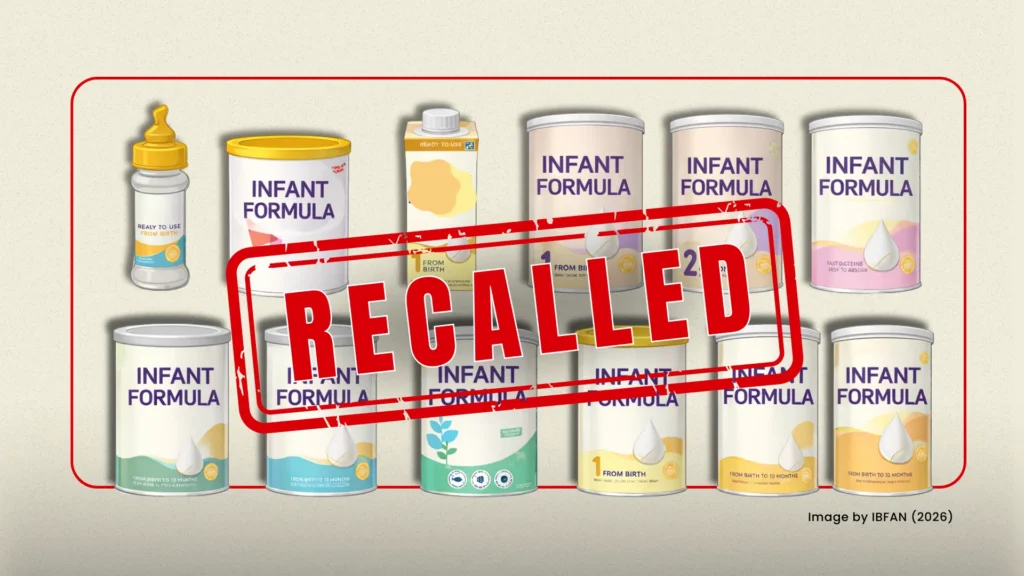
Soon after the ByHeart recall of its Powdered Infant Formulas (PIF) in the USA because of risk of Clostridium botulinum contamination, 60+ countries have recalled specific batches of Nestlé’s infant, follow-on, pre-term and specialised formulas, because of possible contamination by cereulide – a toxin produced by certain strains of a bacteria namely Bacillus cereus that can trigger nausea and vomiting when consumed.(1) Austria’s Health Ministry has said that the recall is the largest in the company’s history, affecting more than 800 products from over 10 Nestlé factories.
This is not verified by Nestle, a company used to food safety scandals and recalls (2) who seems to be trying to pass the blame onto the company who supplied the arachidonic acid (ARA), supposedly the source of the contamination. Initially Nestlé refused to name Cabio Biotech, a Chinese company based in Wuhan. The truth is, Nestlé is responsible for the microbiological safety and quality of both the ingredients and the final product and should have verification procedures in place to audit and select ingredient suppliers. Manufacturers should also be regularly inspected and independently audited by government authorities. (See Yasmine Motarjemi below)
ARA is naturally present in breastmilk alongside thousands of other ingredients that are not present in formula. Industrially synthesised ARA (often derived from fungi) is permitted as an optional, rather than mandatory ingredient in the EU, but by law first infant formula must contain all the mandatory ingredients and are nutritionally equivalent. With little independent, credible research to support their claims, companies use the addition of optional ingredients to justify premium prices and promote formulas as being ‘closer to breastmilk.’ They ignore the fact that breastmilk is a totally different living biological environment, containing co-enzymes that enable the fats to work optimally.(3)
Systemic failings in surveillance and unacceptable delays
Powdered formula is NOT sterile and requires strict manufacturing controls, transparent testing, rapid warning and support for families. The number of contamination outbreaks in recent years highlights systemic failures in formula production, regulatory surveillance, recall systems and crisis communication – that lead not only to interrupted supplies, but to large numbers of infants vulnerable to contamination. This is especially problematic in the Global South and settings where the risks are greater , diagnosis is restricted and access to treatment is reduced. The global online promotion and sale through social media exacerbates these problems, especially when products not registered or regulated at national level. The idealising messages encourage unquestioning trust in the company .
Nestlé is playing down the crisis, saying there have been no ‘confirmed reports’ of illness associated with the products and that its recall is “out of an abundance of caution.” No mention is made of the social media reports of illness, even on their own SMA Facebook page. Parents are confused frightened and shocked that contamination could have happened when they have been repeatedly told to trust the company. The delay in the recall, lack of transparency and robotic AI answers are all undermining the credibility of Nestlé’s response. According to FoodWatch
“Dutch authorities were first notified of the contamination on December 9, following lab tests on November 26 that had shown the presence of Bacillus cereus…Three weeks later, Dutch consumers face a recall… Austrian authorities have said Nestlé conducted a “silent” recall over the Christmas period before issuing public warnings. Van Gemert says this action was inadequate. “For infant formula, a ‘silent’ recall is not an appropriate response when there is a potential unacceptable risk. A silent recall may reduce reputational damage, but it does not protect consumers adequately. Public health must come first, especially for babies.”(4)
IBFAN calls for stricter oversight and controls on promotion
At the recent Codex Committee on Food Hygiene (5) IBFAN succeeded in its call for an urgent revision of the 2009 Code of Hygienic Practice for Powdered Formulae for Infants and Young Children, a guidance that focused on Cronobacter and Salmonella and not adequate for Bacillus cereus that is “unlikely to be deactivated or destroyed by cooking, using boiling water or when making the infant milk.” IBFAN is calling for a revision of the 2007 WHO Guidelines on the Safe preparation, storage and handling of powdered infant formula . These followed the 2005 WHA Resolution (WHA 58.32) that stressed the need for parents and caregivers to be warned about the intrinsic contamination of powdered infant formula. The revised guidelines must not only reduce the risk at manufacturing level, but warn of the food safety risks of global online marketing and sales, forbidding any messaging that is NOT in compliance with WHA recommendations, as already called for in the Codex Code of Ethics in International trade and Food Aid.
Effective elimination of idealising and misleading marketing – much of it now online through social media and highlighted in WHA78.18 Regulating the digital marketing of breast-milk substitutes) – would better inform all parents while protecting breastfeeding and reducing dependence on unsafe products. IBFAN also raised concerns about the need to ensure that food safety authorities, surveillance and verification systems are free from commercial interference.
Nestlé in crisis – are they really trustworthy?
Nestlé, is the world’s largest packaged food company and has faced decades of criticism and consumer boycotts over its human rights abuses. IBFAN, the 46-year old global network working to protect breastfeeding child health, has been at the forefront of criticism of Nestlé’s persistent refusal to abide by United Nations baby food marketing recommendations (in particular the later WHA Resolutions that strengthen and clarify the original 1981 Code) and the risks its marketing poses to child health and survival. Nestlé has a disproportionate influence over food systems and legislation and its marketing has earned the company the “baby killer” label – a label that just won’t come off.(6)
The Company also faces regular charges that 50-70% of its 2000-brand food and drink portfolio is ultra-processed and unhealthy and ongoing charges of child slavery, exploitation of water, plastic pollution, intensive agriculture, risky technologies, mono-cropping, land-and sea-grabbing and double standards on sugar.
Nestlé was clearly in crisis before this latest contamination scare and its share price is now about 42% down from its record high in January 2022, falling 4.6% since the recall began expanding this week. Infant nutrition is part of Nestlé’s Nutrition and Health Science division, that accounts for 16.6% of its total US$101 billion 2024 sales.
Throughout its history, Nestlé has claimed to be “trusted by mothers throughout the world.” It’s surely high time governments took steps to stop Nestlé and all the baby feeding companies from exploiting that trust and harming children.
FoodWatch Summar y:
- Nestlé recalls infant formula across 60+ countries over cereulide contamination traced to third-party ARA oil supplier.
- Analysts estimate up to US$1.3 billion exposure, disputing Nestlé’s claim that the impact is below 0.5% of sales.
- FoodWatch accuses the company and Dutch authorities of a “serious breakdown” in traceability, claiming nearly a month passed before global public recall.
(1) Contamination of formula products is commonplace, ranging from microbes in powdered formulas, insect parts, pesticides, to heavy metals such as lead, aluminium, cadmium. Historically there has been intentional adulteration of melamine and leakages of packaging chemicals has prompted numerous product recalls. Chemical additives to stabilize, emulsify, thicken, regulate acidity, and act as anti-oxidants are all “permitted” by Codex Alimentarius standards, some at regulated levels and others according to “good manufacturing practices”, with their safety declared not by independent and convincing science but on the basis of political consensus and claims of “history of safe use.” There is an inherent ethical difficulty in testing additives on infants below the age of 12 weeks. However, the baby food industry claims additives are essential to “deliver” nutrition to infants. The result is that for decades infants have taken part in mass uncontrolled feeding trials.
Summary of formula recalls since 1982. Marsha Walker.
The source of the toxin cereulide is Bacillus Cereus, a heat and chemical resistant bacteria. Cereulide can trigger nausea and vomiting when consumed but published reports suggest it can also cause multi-organ problems. Cereulide and Emetic Bacillus cereus: Characterizations, Impacts and Public Precautions 15 February 2023
(2) Nestlé’s approach to food Safety
Yasmine Motarjemi, WHO’s Food Safety Senior Officer from 1990-2000 and later Global Director of Food Safety at Nestlé and Assistant Vice-President (2000 to 2010) was forced out of her job after repeatedly raising concerns about Nestlé’s mismanagement of food safety. Yasmine says that all the time she was in post at Nestlé, her department of food quality, the cockpit of the Company was never inspected by government authorities, not even when food incidents occurred. She refused to be silenced and became a whistleblower. Her new book Ce que l’empire Nestlé vous cache (What the Nestlé empire is hiding from you) was published in 2025 Bernard Nicolas, Yasmine Motarjemi.
Here are some extracts from her response to Nestlé’s materiality matrix ‘First, Nestle’s concern in regard to food safety is primarily not to cause mass/collective poisoning which would inevitably come to public attention; however, as long as the problem is not detected, then the product is safe. The company’s limit or criteria of safety is whether the company will be implicated in a safety scandal or not. Second, their concern for safety is whether this will lead to a loss of business, not consumer health, one can see this from the behaviour of the companv. In other words, if one or few consumers get ill and their problems can be fixed with compensation, they would not care much. This is seen as the cost of the business. Otherwise. I do not see an explanation for leaving on the market for over 2 years a product (baby biscuits) which caused choking of infants, while the parents were complaining; the manager responsible was even promoted.”
Whistleblowing: Food Safety and Fraud Food Safety magazine, June/July 2014 “With the extensive industrialization and commercialization of the food supply, the resources of government authorities will never be sufficient to control the safety of the many food operations and products on the market. Also, end-product testing of products, as a sole measure, can in no way be an effective approach for ensuring food safety for detecting and preventing unknown substances that malevolent people may add to products. Therefore, the trust that we can have in food safety depends very much on the following:• Competence and ethics of professionals working in the food industry • Liberty and authority given to the staff to report deficiencies or unethical practices internally, or to authorities, without being subject to retaliation and punitive measures • Commitment by management to address and follow up on reported food safety issues, including structural problems • Vigilance of food safety authorities in following up and investigating the root cause of deficiencies and incidents up to the highest level of company management”
Some important Nestlé food recalls:
2022 Nestlé Buitoni – E.coli: In 2022 the was a major E. coli outbreak in France linked to Nestlé Buitoni’s Fraîch’Up pizzas. Two children died and many fell ill. Investigations found severe hygiene issues and alleged negligence at the Caudry factory led to widespread product recalls.
I want Nestlé to explain’: families fight for answers in Buitoni E coli scandal Angelique Chrisafis 27 Oct 2022 https://www.theguardian.com/business/2022/oct/27/nestle-france-buitoni-e-coli-scandal
Nestlé remains silent on child deaths from contaminated pizzas in France The food giant is citing the ongoing preliminary investigation into its Buitoni pizzas to avoid making any statement. Le Monde April 18, 2022
2015 Maggi Noodles in India In June 2015 400m tons of Nestlé’s Maggi Noodles were destroyed after being banned from sale because of their high lead content. The Indian Government described them as ‘unsafe and hazardous for human consumption.’ Nestlé had 63% of the instant noodles market. One packet of Maggi noodles typically contains 60-70% of the maximum daily intake of salt. The issue was a PR disaster and showed Nestlé’s disregard of safety standards and human rights. At the time Nestlé India spent Rs 300-450 crore (about £56m) annually on ‘advertising and sales promotion’ but only Rs 12-20 crore (about £2m) on ‘laboratory or quality testing.’ (TOI 7.6.15). After the ban, Nestle proposed to collaborate with Food Safety & Standards Authority of India (FSSAI). Click here
(3) Nestlé’s Chinese ARA Supplier Plunges After Swiss Firm Issues Global Recall of Baby Formula YiCai Global, 8.1.26. “Nestlé’s China arm has also released a corresponding list of 30 recalled batches in the Chinese market involving four brands: Lactogen, NAN Bochu, NAN Shuyi, and Wyeth Nutrition Children’s Growth Milk Powder.”
Long-Chain Polyunsaturated Fatty Acids (LCPUFAs) such as DHA and ARA are naturally found in breastmilk. In 1996 when Martek Bio-sciences Corporation first developed synthetic DHA commercially they admitted: “Even if Formulaid (DHA/AHA) had no benefit we think that it would be widely incorporated into most formulas as a marketing tool and to allow companies to promote their formula as ‘closest to human milk’.” In 2010, during the debate about whether these ingredients should allowed either as mandatory or optional ingredients, US FDA stated to Martek (the DHA manufacturer): “The bioactive fatty acids ARA and DHA when consumed in mature human milk are part of a complex matrix that includes, for example, linoleic acid, alpha-linolenic acid, and other polyunsaturated fatty acids. …important physiologic considerations relative to the matrix are not accounted for by the simple addition of LCPUFA s to infant formula.” EFSA said that “none of the studies presented has shown a benefit of either DHA alone or DHA plus ARA on visual development as compared to the breast fed controlgroup. For more see this briefing from 2010 10 reasons to stop this DHA claim. Archive reports on EU Legislation
Nestle infant formula recall widens to Africa, the Americas and Asia. Nestlé recalls infant formula batches in 25 countries over toxin risk Alexander Marrow and Oliver Hirt, Reuters 7.1.26. “Problems with baby formula can be damaging for companies. Reckitt is exploring options, including a sale, for its Mead Johnson business, which faces hundreds of lawsuits in the US over claims – which it denies – that its infant formula can cause a fatal intestinal illness in premature babies. Nestlé, whose shares have fallen more than 3 percent in the last two sessions, controls almost a quarter of the $92.2 billion (NZ$159.4 billion) global infant nutrition market, according to SkyQuest Technology Group. Nestle does not publish sales data, but infant formula is part of its Nutrition and Health Science division, which accounted for 16.6 percent of total sales of 91.4 billion Swiss francs (NZ$198.8 billion) in 2024.”
(4) Nestlé’s reputation in danger over global infant formula recall The CPG major faces the biggest product recall in its history – and investors want answers. 9.1.2026, Dairy Reporter
Nestlé under fire over “unacceptable” delay in historic infant formula recall 8 Jan 2026 Food Ingredients, Louis Gore Langton https://www.foodingredientsfirst.com/news/nestle-infant-formula-recall-cereulide.html
Massive Nestlé Baby Food Recall, Food Watch, NEWS 08.01.2026 https://www.foodwatch.org/en/massive-nestle-baby-food-recall
Nestle issues global recall of some baby formula products over toxin fearsBBC News Archie Mitchell. Business reporter. 6th January 2026,
Nestlé alerted the EU’s Rapid Alert System for Food and Feed (RASFF) on 12 of December. RASFF is the EU’s mechanism for rapidly sharing information about serious risks to human or animal health linked to food or feed. Its legal basis is Article 50 of Regulation (EC) No 178/2002 (General Food Law).
HOY International Business Channel https://www.facebook.com/reel/838427072292913
First Steps Nutrition Trust statement 7th January 2026
(5) Codex is the UN food standard-setting body whose Guidelines and standards form the basis of national legislation. The WHO Guideline on the Safe preparation, storage and handling of powdered infant formula published in 2007 should also be updated.
(6) Breastfeeding protects infants from respiratory infections, diarrhoeal diseases, and other potentially life-threatening ailments. Protecting and supporting breastfeeding is recognized as a critical component of securing children’s inalienable right to survival, development and the highest attainable standard of health. Exclusive breastfeeding has the single largest impact on child mortality of any preventive intervention. Globally, poor breastfeeding practices, contribute to an estimated 11.6% of mortality in children under five years of age.”
PDF of Food Standards Agency list of products affected
Some responses from Parents on the SMA Facebook Page
- I saw this this morning and my baby boy (almost 4 months old) has been experiencing severe vomiting, nausea, severe stomach cramps and has generally been so unwell (hes usually very very content). We noticed he’d had several batches of the recalled milk. Called 111 who said go straight to the children’s hospital, and they confirmed hes been poisoned (like food poisoning symptoms – no lasting effects) but the hospital have advised us to change formulas and to ride it out. They said it’s likely to be out of his system in 7-10 days. Says no confirmed illnesses but my baby and many others have been affected!!!
- Most people won’t be interested in a refund. What we are interested in is that your products are safe for our infants to have and for you to tell us the steps you’re taking to prevent this happening again. If not for the fact we’re stuck with the Amino acid based formula due to my son’s CMPA I’d have changed brand and not looked back. However we have no choice but to use Alfamino and need to trust that he will be okay and the next set of tins will be fine to use. When it comes to something like baby formulas this just should not be happening.
- I know as a large company you get a lot of complaints, so your responses have to be in a certain manner, but you could try adapting your comments, I don’t think you realise the seriousness of your quality assurance failure. Especially as these are babies, not us adults with hardy immune systems – babies! Could try being less of a robot at this distressing time for families. I’m pregnant and was told to use SMA when baby is born and came highly recommended, you’re gonna have to do better than this, if you want customers to return to your products after this! Why initially release recall details at 5pm and then close your phone lines at 6pm? What proportion of the supply in circulation has been affected and over what time period have these been on sale/prescribed? You have supplied recall batch numbers, and stated there are some unaffected batches, how many of these are in circulation and available? Regardless of batch numbers, several pharmacies I’ve spoken to are withdrawing all stock from their shelves and won’t take further orders ; can you guarantee only the batch numbers you’ve issued are affected and what availability is there of untainted milk? Presumably there are now major supply issues? Some transparency needed.
- Are ye sure there’s not other batch numbers that need 2 be recalled? My son has had diarrhea and vomiting. He was vomiting for 3 days and he has diarrhea the past 10 days. Took him to the doctor last week and was put down as viral infection but now thinking has it something to do with his food??
- why is your careline closed!!?? Trying to call, our little one has already had a tin of a recalled batch!!
- ..read the comments all similar to what poor Franks been through because of the potential contamination, hopefully you can get a refund on the unopened tubs you have with the matching batch number. Absolutely disgusting that your poor baby’s been struggling for months unknown and now it could be because of this
- I don’t think a sorry is good enough. We trusted the product. My baby has had 2 tins and has had increased vomiting. Cheers!
- You are using AI to respond to these comments, if feels you don’t understand the seriousness of this matter…My 5 months old has also been affected with this
