
WHO’s 158th Executive Board – IBFAN calls for Resolution to tackle intrinsic contamination of formula.
158th session of the WHO Executive Board
EB158 | Geneva, Switzerland | 2–7 February, 2026
The 158th Session of the Executive Board of the World Health Organization (WHO) will be held in Geneva from 2 to 7 February 2026.
Agenda 25 (Thursday, 5 February) – The biennial report on the International Code of Marketing of Breast-milk Substitutes will be presented.
IBFAN believes there is an urgent need for a new WHA Resolution to update the 20 year-old WHO and Codex guidelines on intrinsic contamination of powdered formula. This could help reduce the serious health risk for infants, our most vulnerable population. The WHO Guidelines on the Safe preparation, storage and handling of powdered infant formula and the Codex Code of Hygienic Practice for Powdered Formulae for Infants and Young Children are not adequate for C botulinum, Bacillus cereus or spores that are “unlikely to be deactivated or destroyed by cooking, using boiling water or when making the infant milk.”
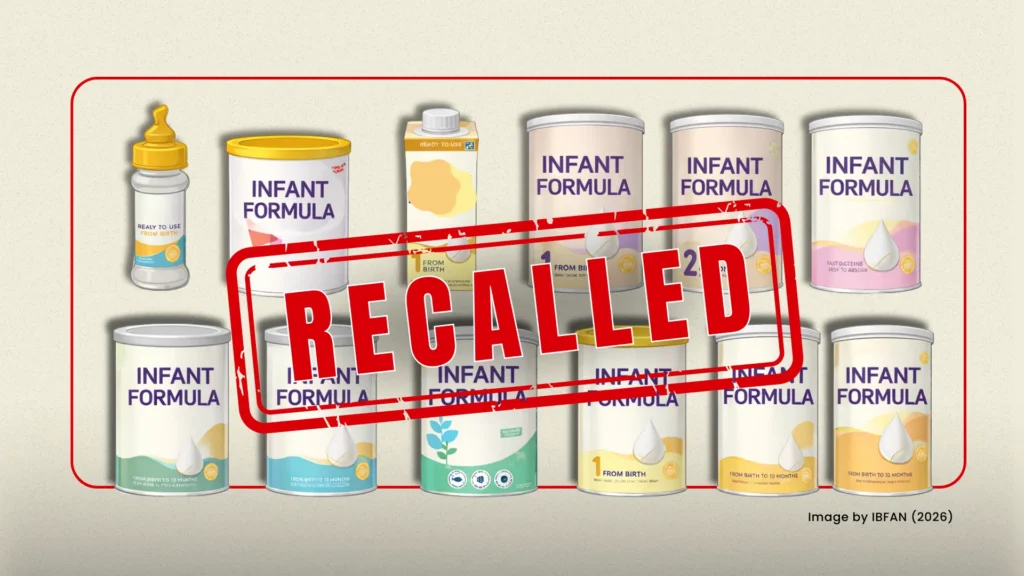
The recalls have highlighted systemic failures in formula and baby food production, regulatory surveillance, transparency, recall systems and crisis communication and the need for independent and regular scrutiny of manufacturing processes and facilities. The idealising online promotion and export of powdered baby food products exacerbates food safety risks, and persuades parents to unquestioningly trust products, undermining breastfeeding that can a be lifeline for children.
Agenda 16 (Wednesday, 4 February) – Another relevant point on the agenda is WHO’s work in emergencies.
The Executive Board is composed of 34 technically qualified members, elected for three-year terms. Its main function is to implement the decisions of the World Health Assembly and to facilitate its work.
CABO VERDE, CAMEROON, CENTRAL AFRICAN REPUBLIC, COMOROS, LESOTHO , TOGO (Vice-Chair), ZIMBABWE, BARBADOS, CHILE, COSTA RICA, EL SALVADOR, HAITI, PANAMA (Rapporteur), DEMOCRATIC PEOPLE’S REPUBLIC OF KOREA (Pyongyang), NEPAL, THAILAND (Vice-Chair), BULGARIA, ISRAEL, NORWAY (Vice-Chair), POLAND, SPAIN, SWITZERLAND, UKRAINE, EGYPT, LEBANON, QATAR, SAUDI ARABIA (Vice-Chair), SOMALIA, AUSTRALIA (Chair), BRUNEI DARUSSALAM, JAPAN, REPUBLIC OF KOREA (Seoul) SOLOMON ISLANDS.
Addresses of national embassies and information on Preparations for EB158 & PBAC43 are also available.
2026 is the reporting year for the International Code.
Click here for the Report by the Director-General on Maternal, infant and young child nutrition. Below are excerpts from the report:
Progress in implementing the International Code of Marketing of Breast-milk Substitutes and related Health Assembly resolutions
19. Member States continue to strengthen legislation and regulatory instruments giving effect to the International Code. The Status Report 2024 found that 146 of the 194 WHO Member States have adopted legal measures to implement at least some of the provisions in the Code, covering 91% of global annual births, and that 33 Member States have legal measures substantially aligned with the Code. Since the publication of the Status Report 2024, Argentina, Benin, Cuba, Indonesia, Kuwait, Senegal and the United Arab Emirates have strengthened their legal measures to align with the Code.
20. WHO and UNICEF organized a number of regional workshops to strengthen Code legislation, monitoring and enforcement in 2024 and 2025. Workshops in eastern Europe and central Asia (eight countries), western Africa (11 countries), southern Africa (four countries), and the Caribbean and Latin America developed solutions and actions to strengthen Code implementation, monitoring and enforcement.
21. To advance protection against conflicts of interest in healthcare, WHO continued to address the sponsorship of healthcare providers and professional organizations by manufacturers of foods for infants and young children. WHO published a series of briefs to assist healthcare professional associations in ending this sponsorship, including a model sponsorship policy,6 a brief on alternative funding options,7 and a compendium of case studies of associations that have refused sponsorship.8
22. To advance the development of monitoring systems and technologies for identifying marketing of breast-milk substitutes in digital environments, the WHO Secretariat has convened civil society and academics to compare various models for identifying digital marketing activities, including social media listening platforms, cell phone screenshots, artificial intelligence analysis of online content and user reports.
23. WHO and UNICEF have been participating in the Codex Electronic Working Group to develop a new Codex standard for complementary foods. WHO’s inputs have been partially based on the Nutrient and Promotion Profile Models from Europe9 and south-east Asia.10 A draft text on the labelling section of the standard is being prepared.
24. The annual Global Breastfeeding Scorecard documents country progress in improving breastfeeding rates and in implementing policy and programmatic indicators to protect and support breastfeeding. The 2024 Scorecard documented that improvements in breastfeeding rates have been substantial in some countries, with 23 countries reporting gains exceeding 10 percentage points over the previous five years. The Scorecard also showed that rates of continued breastfeeding are almost two and a half times higher in countries with legislation substantially aligned with the Code compared to countries with no Code legislation.
Report of the Ombudsperson (19th December EB158/INF./2)
Below are excerpts from this important report that address, among other things, the impact of the severe financial cuts on WHO staff and their families:
3. The year 2025 may well go down as the most difficult year yet in the history of WHO. Indeed, it was characterized by unprecedented budget cuts. In the light of this situation and the ensuing crisis, the Organization took action to re-evaluate its strategic and financial approach and organizational structure. Measures on cost reductions and efficiencies were introduced as early as January 2025 in relation to the strategic alignment of available financing with key priorities. An overarching prioritization and realignment exercise was launched to identify core areas of focus and guide human resources decisions …
6. The Ombudsperson would like to stress that during this challenging year, WHO has not ceded to the considerable pressure placed upon it to rapidly implement measures that might be financially expedient in the short term but would ultimately be at odds with core WHO values …
10. When the Organization clearly states the rules and policies that will be applied and can subsequently demonstrate that it has respected this legal framework, trust is built and goodwill remains a hallmark of relations between the employer and the employee. This is particularly true in areas of ambiguity, and doing so maintains the Organization’s credibility. When policies reflect WHO values ‒ even at a financial cost ‒ staff recognize the integrity of that approach. Special attention should be given to fully explaining amendments, changes in policies and the rationale for exceptions in order to avoid misunderstandings and even conflicts, and to maintain trust …
15. Knowing the challenges ahead, it is noted with concern that there has been a drastic reduction in the number of professional ombudspersons in the Organization in 2025. There is now only one ombudsperson in the Office of the Ombudsperson and Mediation Services supporting employees at all headquarters duty stations (including IARC, ICC and UNAIDS). Further, only the regional offices for the Americas, Europe and the Eastern Mediterranean have a full-time ombudsperson….
Important links
- Main documents
- Live webcasts
- Preliminary Daily Timetable
- Provisional agenda (annotated)
- DG Report: Maternal, infant ...
- Safe preparation...: guidelines
- Code of hygienic practice...
- Agenda item 16
- Agenda item 25
- Agenda item 33.2
- Members of the Executive Board
- Chair and Officers of the Board
- Embassies of Member States
- Preparations for EB158 & PBAC43
News
Recall - Nestlé’s credibility questioned as formulas recalled in 60+ countries over contamination risk
FIND YOUR NATIONAL LAW on IBFAN’s Website

With information from Baby Milk Action
