
WHA79: Contaminated Commercial Formula – the need for a global response
Update 25 May, 2026 (IBFAN Statements)
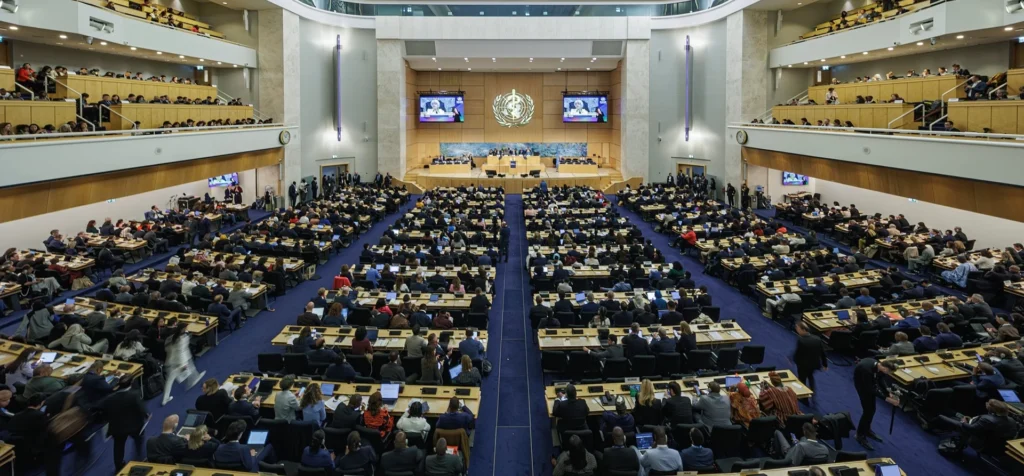
#WHA79 – 79th World Health Assembly – Geneva, Switzerland, 18-23 May 2026.
#WHA79
79th World Health Assembly
Geneva, Switzerland
18-23 May 2026.

Infant formula contamination crisis · Since November 2025 · Source: IBFAN / ibfan.org
+ SEE THE FULL LIST OF AFFECTED COUNTRIES
Unprecedented global recall of formula
Contamination with the toxin cereulide has triggered a widespread formula recall affecting Nestlé, Danone, Lactalis and other manufacturers.
130 countries are affected. The recalls cover infant, follow-on, pre-term and specialised formulas.
Last year formula produced by US company ByHeart was contaminated by Clostridium botulinum. 48 infants were reported hospitalized with life-threatening botulism.
This is not an isolated incident. It is a systemic failure.
THE INDUSTRY'S RESPONSE?
Companies have blamed external suppliers, claimed no “proven causal link”, and have described recalls as “voluntary” and taken “out of an abundance of caution.”
Meanwhile, the legal reckoning has begun:
- Criminal investigations and complaints in France into infant deaths, delayed recalls and lack of transparency.
- Police investigations in the Czech Republic for endangering health through harmful food.
- Civil claims for damages in Northern Ireland (United Kingdom).
GUIDELINES HAVE NOT KEPT PACE
WHO and Codex guidance on manufacturing safe preparation of formula (2007, 2008) are inadequate. They do not address the emerging risks associated with new processing technologies and the ingredients that may be contaminated by spore-forming pathogens and bacterial toxins.
A FOOD SYSTEM BUILT ON FRAGILITY
This crisis exposes the dangers of food systems that are dependent on a handful of corporations. In this case, a single ingredient was reportedly sourced from a single supplier and then distributed globally.
Cross-border online promotion has increased dependency on commercial products beyond actual need, allowing products to circulate in countries where they may not be registered and are difficult to trace.
WHA Resolution 78.18 recommends that member states prevent cross-border promotion.
BABIES AND FAMILIES FACE THE GREATEST RISK
In a world where the feeding of babies has become the object of commerce and trade, the consequences of system failures fall hardest on the most vulnerable. Contaminations and recalls trigger widespread fear and anxiety in families around the world.
Families in the Global South and in emergency contexts face the most severe risks — where testing, detection, treatment and access to safe alternatives may be severely limited. These are the families most often forgotten.
URGENT ACTION NEEDED
InDecember 2025, Codex agreed to update its guidance and WHO and FAO began updating theirs. In February 2026, EFSA published an urgent scientific risk assessment and defined a threshold for cereulide. The EU implemented emergency measures governing imports into the EU.
This is a start, but Codex processes take years. Urgent action is needed now.
Globalised, industrialised formula production – concentrated in the hands of a few corporations and dependent on opaque supply chains – demands far greater oversight, transparency, inspection and enforcement than it currently receives.
What is needed is a twin political commitment: the will to genuinely support and enable families to breastfeed – removing the barriers, and ending the aggressive commercial promotion that undermines it.
For those who use formula, the will to make that product as safe as it can be.
Despite unprecedented cuts to its budget and staffing, WHO has demonstrated its willingness to tackle this global health challenge.
Member States must now match that commitment.
CALLS TO ACTION
Independent Oversight: Mandatory inspections of manufacturing; findings made public; enforceable sanctions; whistle-blowers protected.
Effective Communication: Timely, accurate information to health workers, parents and carers. Monitoring systems with publicly available results.
Full Accountability: Dedicated resourcing for low-income and emergency-affected populations. Investigate and sanction companies who delay recalls, withhold information and mislead consumers, across borders.
Enforce WHA Resolution 78.18 on digital marketing of breastmilk substitutes to close digital loopholes.
Invest in Breastfeeding Support including enforcing workplace protections.

IBFAN AT WHA79
Below, see the record of IBFAN’s participation at the 79th World Health Assembly, with updates added throughout the event.
IBFAN is in Geneva for the 79th World Health Assembly, bringing to the global stage an urgent message: the infant formula contamination crisis is not an isolated incident — it is a systemic failure that demands an immediate global response.
For 47 years, IBFAN has worked alongside WHO and civil society to protect families from misleading marketing and unsafe products. This week, that work is more urgent than ever. With 130+ countries affected by recalls, ongoing judicial inquiries into infant deaths, and guidelines nearly 20 years out of date, the evidence is clear: the current system is failing the families it was meant to protect.
IBFAN is calling on WHO Member States to act – to mandate independent oversight of manufacturing, to update WHO and Codex guidelines, and to enforce existing resolutions on the digital marketing of breastmilk substitutes. The families most at risk – in the Global South and in emergency contexts – cannot wait for slow regulatory processes.
On Friday, 22 May, IBFAN, ILCA (International Lactation Consultant Association), Burundi, Panama and Ecuador will co-host a Side Event at WHO Headquarters to address the contamination crisis and its impact on families worldwide. Because protecting all babies – those who are breastfed and those who are fed formula – is not a choice. It is a commitment.

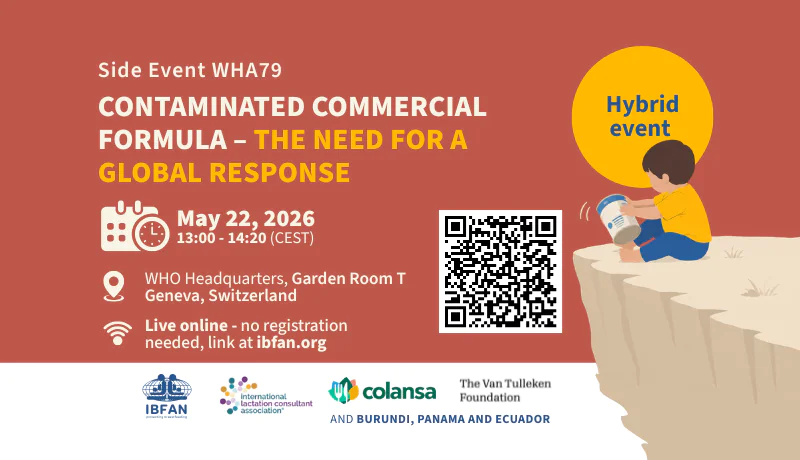
SIDE EVENT (hybrid event)
Contaminated Commercial Formula
– the need for a global response
- Friday, May 22, 2026
- 13:00 - 14:20
- WHO Headquarters, Garden Room T
- prundall@babymilkaction.org
- REGISTRATION: SIDE EVENT
Over the years misleading marketing and intrinsic contamination of commercial formula – a child’s first taste of ultra-processed products – has led to infant fatalities, factory closures, interrupted supplies and distress to families. The detection of a new type of spore-forming contamination since November 2025 has led to ongoing recalls from over 130 countries, judicial inquiries into infant deaths in France and legal challenges about delays, lack of transparency, fraud and manslaughter.
As global networks, IBFAN and ILCA will focus on the impact this crisis has on all families, especially those in the Global South and in emergency contexts where testing, detection, treatment and safe alternatives may be limited. Families that are often forgotten.
The event will call on Member States to work towards a more resilient first-food systems, with mandatory independent oversight of manufacturing facilities, with health care systems that warn, monitor and document health problems during outbreaks. Full implementation of WHO recommendations and resolutions are essential safeguards for all babies – those who are breastfed and those who are fed formulas.
The online promotion formula (forbidden by WHA78.18) creates dependence on commercial products beyond the actual need. Cross border sales exacerbate the inherent safety risks of formula use, allowing products to enter countries where they may not be registered and are difficult to track. Meanwhile, the baby food industry has passed blame to external suppliers, claimed there is no causal link with their products and that they are acting “out of an abundance of caution.”
This food crisis illustrates the risks of allowing food systems to be dependent on a handful of corporations, with a single global ingredient, sourced from one supplier, causing immense harm. Alongside speakers from WHO, UNICEF, Parliamentarians and Member States, Yasmine Motarjemi, a food safety expert with a unique experience as head of Food Safety Departments in both WHO and Nestlé, will explain how food systems and food culture needs to change and why whistleblowers need to be heard and protected.
Important links
WHA 79
Side Event (hybrid)
SIDE EVENT 79th WHA
IBFAN, ILCA, Burundi, Panama and Ecuador
Contaminated Commercial Formula – the need for a global response
- Friday, May 22, 2026
- 13:00 - 14:20
- WHO Headquarters, Garden Room T
- prundall@babymilkaction.org
- Registration: Side Event
FIND YOUR NATIONAL LAW on IBFAN’s Website

IBFAN Statements
IBFAN is making the following statements at this year’s Assembly:

Check below the statements from IBFAN during WHA 79:
Agenda item 13 - Public Health Emergencies: preparedness and response
To be read by Juanita Jauer Steichen
IBFAN/LLL France (19/05/2026)
As a member of the Inter-agency Infant Feeding in Emergencies, IBFAN is very concerned about new Codex guidelines that will allow flexibility for labelling, including of baby formulas and foods, during emergencies.
The onus will be on Member States to stop exploitation by those seeking to undermine breastfeeding and create markets. The fact is few Member States have effective emergency preparedness plans so they lack the capacity to recognise deceptive labelling. During COVID formulas shockingly claimed to provide immunity or aid ‘recovery.’ Any deregulation risks the health and survival of displaced families, while undermining tracking of contaminated products. While ALL women have the sovereign right to make infant feeding decisions, complete and accurate labelling is essential, especially in emergency situations. Its time for Member States to ensure this.
Agenda Item 12.4 - Universal health coverage
To be read by Juanita Jauer Steichen
IBFAN/LLL France (22/05/2026)
IBFAN Strongly supports the right to access to free and adequate health care. To be effective, strong conflicts of interest safeguards are needed to prevent harmful industry practices that negatively impact health. Prevention for optimal health is critical and starts with infant and young child feeding – breastfeeding and avoidance of ultra-processed products.Companies process raw ingredients to achieve sweetness while claiming products are healthy. Sweetness is addictive and sets up taste preferences in children, programming them to consume ultra processed products. The international higher levels of added sugar content by companies targeting the global south is an unethical and unacceptable double standard. IBFAN urges governments to fully implement the Code – now 45 years old – and to enact legislation covering all products marketed for infants and children.”
Agenda item 15.4 - Maternal, infant and young child nutrition
To be read by Tshimi Lynn Moeng
IBFAN Africa (23/05/2026)
New threats to infant health are disaster capitalism. Firstly, the intrinsic contamination of formula – a child’s first UPF – has led to legal actions on infant deaths and illness. A single contaminated ingredient was distributed to 130 countries – causing unprecedented recalls. Poor surveillance, lack of transparency, fraud and poor crisis management have eroded public trust in the current food system, that is dependent on a handful of corporations. Secondly, Codex may soon allow weaker labelling of food products in emergencies. This opens the door to commercial exploitation, double standards and unethical dumping of products in the global south. Please Member States, send health delegates to Codex and ensure that products for babies are excluded from this proposal.
The Crisis in Focus
A selection of reports, investigations and official responses that document the scale and impact of the infant formula contamination crisis
France Télévisions Report
Infant Formula: Poison in Baby Bottles?
Includes parents of babies who suffered or died and who are struggling to find to find answers
26/03/2026

The infant botulism caused by contamination of Byheart formulas in November was followed in January 2026 with news of cereulide* contamination of Nestlé, Danone and other formulas. Formula has been exported to more than 100 countries; there are ongoing judicial inquiries into infant deaths in France and legal challenges about recall delays, lack of transparency, fraud and manslaughter. Because of the lack of transparency the real sequence of events is unclear, but cereulide contamination of formula occurred well before the recalls in Dec 2025.
Meanwhile industry has obfuscated and claimed there is no evidence of a causal link between the illnesses and the formula. Nestlé passed any blame to external Chinese suppliers and still claims the recalls are “out of an abundance of caution.” Parents of children who fell sick or died have been left with denial,robotic answer-phone messages, limited treatment and poor access to recall information or support. Public trust in food systems has been destroyed.
*Nestlé’s infant, follow-on, pre-term and specialised formulas, were recalled because of possible contamination by cereulide – traced back to the optional ingredient arachidonic acid (ARA) Synthesised ARA made from funghi is added to justify premium prices and promote formulas as being ‘closer to breastmilk.’ but there is no convincing proof that added to formula it replicates breastmilk or improves outcomes. Breastmilk is a totally different living biological environment with co-enzymes that help fats to work optimally.
WHO and EU OFFICIAL ACTION
December 2025 — Codex: IBFAN’s request to the Codex Food Hygiene Committee prompted the updating of Codex advice.
February 2026 — WHO: WHO starts the updating of its risk assessments and scientific advice. See also: WHO Disease Outbreak News update on global action.
February–March 2026 — European Union: EU Commission starts checking 50% of formula imports from China.
February 2026 — France: The National Assembly presented a Motion for a Resolution seeking the establishment of a committee of inquiry to assess the responsibility of multinational companies in cases of food contamination and the State’s strategy for anticipating and addressing such incidents.
“…Instead of communicating about health risks in accordance with the precautionary principle, multinationals are attempting to downplay the risks to the public. In France, on 13 January, Nestlé attempted to reassure its shareholders by apologising and claiming that no babies were ill. However, two criminal investigations have been launched in Bordeaux and Angers following the recent deaths of two infants who had consumed infant formula recalled by Nestlé. … All the facts mentioned should therefore lead Parliament to shed full light on the responsibility of multinational agri-food companies in the contaminated milk scandal, but also to exercise its role in overseeing the Government, as recent revelations raise fears of a lack of responsiveness to a public health risk.” — National Assembly 2422 (English translation)
EU Parliament Hearing on cereulide contamination
March 24, 2026

Committee on the Environment, Climate and Food Safety Ordinary meeting ENVI Committee meeting – Mr Koen Van Dyke, from the European Commission’s DG Santé, answers questions from MEPs.
Important links
Guide to the 158th Executive Board — with IBFAN Interventions The 158th session of the Executive Board will take place at WHO HQ in Geneva, 2–7 February 2026.
International food safety event: Infant formula and products containing arachidonic acid oil contaminated with cereulide toxin – Multi-country
13 March 2026
Situation at a glance – Multi-country recalls of infant formula and other products have been initiated after cereulide toxin, was detected in batches of multiple internationally distributed brands. Investigations have identified arachidonic acid (ARA) oil, used as an ingredient in the implicated products, as the source of contamination. However, the full root cause analysis and complete traceability of all affected batches remains under investigation. Contaminated formulae, nutritional products, and oil mixes have been distributed to 99 countries and territories across six WHO Regions, with the first product recalls initiated on 10 December 2025. Between 1 January and 25 February 2026, 144 suspected and confirmed cases were reported across ten countries in three WHO Regions, with investigations ongoing. Based on the available information, WHO assesses the overall public health risk as moderate due to the vulnerability of the affected population (infants), the ongoing uncertainty regarding the full extent of distribution and exposure, and remaining gaps in case detection and root cause information. (…)
IBFAN interventions at the Executive Board Meeting
Agenda Item 25 — Thursday, 5 February 2026
The biennial reporting year for the International Code. See: DG Report on Maternal, Infant and Young Child Nutrition.
IBFAN believes there is an urgent need for a new WHA Resolution to update the 20-year-old WHO and Codex guidelines on intrinsic contamination of powdered formula. This could help reduce the serious health risk for infants, our most vulnerable population. The WHO Guidelines on the Safe Preparation, Storage and Handling of Powdered Infant Formula and the Codex Code of Hygienic Practice for Powdered Formulae for Infants and Young Children are not adequate for C. botulinum, Bacillus cereus or spores that are “unlikely to be deactivated or destroyed by cooking, using boiling water or when making the infant milk.”
The recalls have highlighted systemic failures in formula and baby food production, regulatory surveillance, transparency, recall systems and crisis communication — and the need for independent and regular scrutiny of manufacturing processes and facilities. The idealising online promotion and export of powdered baby food products exacerbates food safety risks, and persuades parents to unquestioningly trust products, undermining breastfeeding that can be a lifeline for children.
Maternal, Infant and Young Child Nutrition
Contamination of commercial formulas has led to infant fatalities, factory closures, interrupted supplies, legal actions and much distress to families. They have exposed systemic failures in formula production, regulatory surveillance, recall systems and crisis management.
Cross-border social media marketing exacerbates food safety risks, enabling contaminated unregistered products to enter countries where treatment may not be available. The idealised marketing misleads and instils unquestioning trust in a risky product. Governments must take the lead in changing food safety cultures and ensure independent verification. Manufacturers and authorities must listen to — not punish — whistle-blowers.
Codex and WHO Guidelines are now nearly 20 years old and no longer adequate. A global response led by WHO is urgently needed to better protect families whose trust has been betrayed.
Contamination of commercial formulas has led to infant fatalities, factory closures, interrupted supplies, legal actions and much distress to families. They have exposed systemic failures in formula production, regulatory surveillance, recall systems and crisis management.
Cross-border social media marketing exacerbates food safety risks, enabling contaminated unregistered products to enter countries where treatment may not be available. The idealised marketing misleads and instils unquestioning trust in a risky product. Governments must take the lead in changing food safety cultures and ensure independent verification. Manufacturers and authorities must listen to — not punish — whistle-blowers.
Codex and WHO Guidelines are now nearly 20 years old and no longer adequate. A global response led by WHO is urgently needed to better protect families whose trust has been betrayed.
SIDE EVENT (hybrid event)
Contaminated Commercial Formula
– the need for a global response
- Friday, May 22, 2026
- 13:00 - 14:20
- WHO Headquarters, Garden Room T
- prundall@babymilkaction.org
- REGISTRATION: SIDE EVENT
Over the years misleading marketing and intrinsic contamination of commercial formula – a child’s first taste of ultra-processed products – has led to infant fatalities, factory closures, interrupted supplies and distress to families. The detection of a new type of spore-forming contamination since November 2025 has led to ongoing recalls from over 130 countries, judicial inquiries into infant deaths in France and legal challenges about delays, lack of transparency, fraud and manslaughter.
As global networks, IBFAN and ILCA will focus on the impact this crisis has on all families, especially those in the Global South and in emergency contexts where testing, detection, treatment and safe alternatives may be limited. Families that are often forgotten.
The event will call on Member States to work towards a more resilient first-food systems, with mandatory independent oversight of manufacturing facilities, with health care systems that warn, monitor and document health problems during outbreaks. Full implementation of WHO recommendations and resolutions are essential safeguards for all babies – those who are breastfed and those who are fed formulas.
The online promotion formula (forbidden by WHA78.18) creates dependence on commercial products beyond the actual need. Cross border sales exacerbate the inherent safety risks of formula use, allowing products to enter countries where they may not be registered and are difficult to track. Meanwhile, the baby food industry has passed blame to external suppliers, claimed there is no causal link with their products and that they are acting “out of an abundance of caution.”
This food crisis illustrates the risks of allowing food systems to be dependent on a handful of corporations, with a single global ingredient, sourced from one supplier, causing immense harm. Alongside speakers from WHO, UNICEF, Parliamentarians and Member States, Yasmine Motarjemi, a food safety expert with a unique experience as head of Food Safety Departments in both WHO and Nestlé, will explain how food systems and food culture needs to change and why whistleblowers need to be heard and protected.
Read the article on the WHA79 Side Event — featuring the key speaker quotes.
Important links
WHA 79
Side Event (hybrid)
SIDE EVENT 79th WHA
IBFAN, ILCA, Burundi, Panama and Ecuador
Contaminated Commercial Formula – the need for a global response
- Friday, May 22, 2026
- 13:00 - 14:20
- WHO Headquarters, Garden Room T
- prundall@babymilkaction.org
- Registration: Side Event
FIND YOUR NATIONAL LAW on IBFAN’s Website
With information from Baby Milk Action
